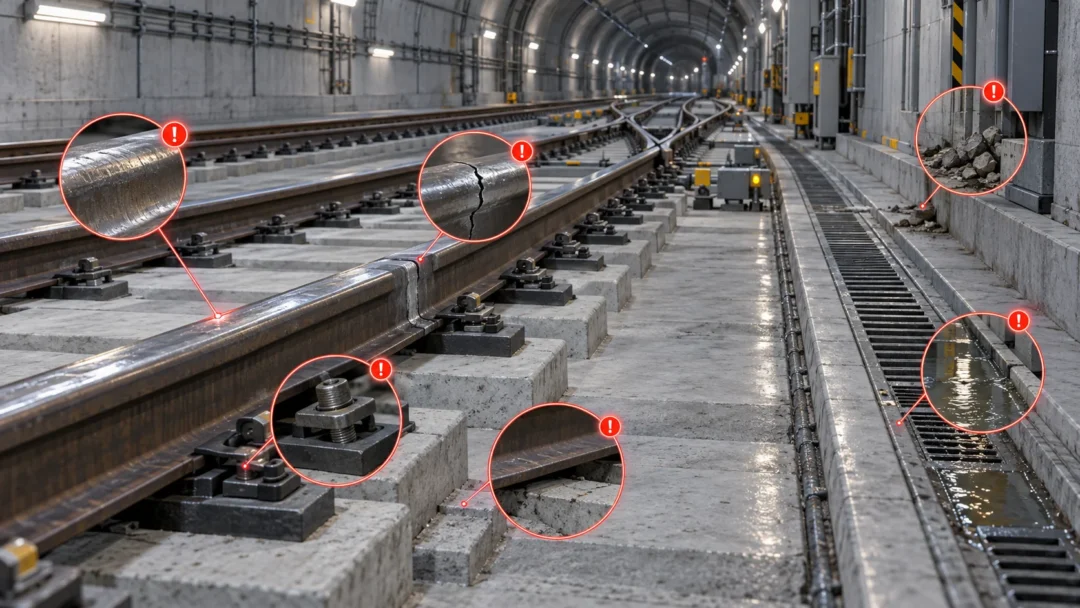
Metro rail track maintenance risks include broken or worn rails, cracked welds, poor track geometry, damaged fasteners, turnout defects, unsupported sleepers, deteriorated track beds, drainage failures and weather-related changes. A useful inspection program connects each defect to its likely operating consequence, then selects monitoring, repair, grinding or component replacement based on measured condition.
This guide focuses on track infrastructure. It draws on the risk categories published in the Chinese Ministry of Transport's 2024 Measures for the Management of Classified Operational Safety Risks and Hidden-Hazard Investigation in Urban Rail Transit. The source requires operators to identify risks, assess their level, define controls and maintain a risk database. It does not prescribe one universal maintenance interval or repair method.
Quick Risk Map
| Track area | Typical warning signs | Main operating concern | Typical maintenance response |
|---|---|---|---|
| Rail and welds | Cracks, wear, corrugation, spalling, joint movement | Vibration, noise, loss of geometry or rail failure | Measure, test, grind when suitable, weld-repair or replace |
| Track geometry | Gauge widening, twist, alignment or level deviation | Poor vehicle response and increased derailment risk | Geometry measurement, fastening and support correction, tamping or slab repair |
| Turnouts | Poor switch-point fit, damaged fasteners, worn running surfaces | Misdirection, impact loading or turnout damage | Inspect geometry and mechanisms, repair components, profile-grind where appropriate |
| Sleepers and track bed | Cracks, voids, settlement, mud pumping | Reduced support and rising dynamic loads | Restore support, drainage and geometry; replace failed components |
| Drainage and environment | Standing water, leakage, heat, ice or debris | Track movement, corrosion, low adhesion or obstruction | Remove immediate hazard, restore drainage, increase seasonal inspection |
The response column is deliberately broad. Maintenance teams still need defect measurements, local standards, traffic conditions and engineering approval before choosing an intervention.
Why Metro Track Risk Is Different
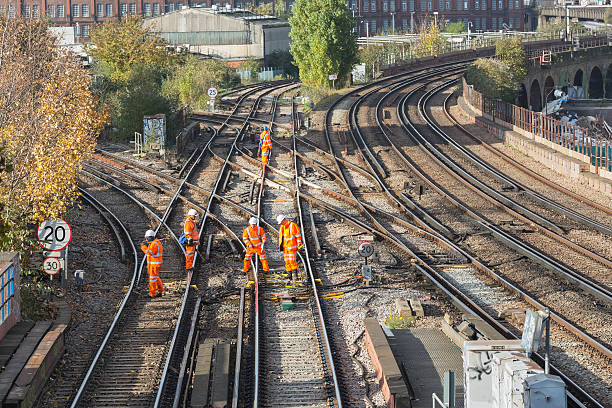
Metro infrastructure works under tight operating windows. Curves can be sharp, service frequency is high, tunnels restrict access, and maintenance often takes place during short nighttime possessions. A defect that appears minor during a visual walk may develop quickly under repeated wheel loads.
Risk also travels across asset boundaries. Water leaking through a tunnel can affect fasteners, insulated joints, the track bed and electrical equipment. A poorly supported sleeper changes wheel–rail loading. That loading may then accelerate corrugation, fastener loosening or local rail damage. For a broader planning framework, our guide to different types of railway track maintenance distinguishes routine, preventive, corrective and emergency work.
For that reason, a list of defects is only the starting point. The inspection record should show where the defect is, how it is changing, what consequence it could produce, and what control remains in place until permanent repair.
1. Rail Fracture and Weld Defects
A rail fracture is one of the clearest high-consequence track risks. The initiating condition may be internal fatigue, a damaged weld, a bolted-joint defect, impact damage or a surface crack that has propagated below the removable layer.
Visual inspection alone cannot determine crack depth. Metro maintenance programs normally combine visual checks with suitable non-destructive testing and geometry or profile measurements. The selected method must match the defect location and rail condition.
Key items to record include:
- The defect's chainage and position on the rail section
- Whether it is associated with a weld, joint, drilling or previous repair
- Visible length and orientation
- Test result and change since the previous inspection
- Any temporary speed restriction or monitoring requirement
Grinding is suitable for selected surface defects when enough sound rail remains and the removal plan stays within the approved rail profile and wear limits. It is not a repair for a through-crack, a deep internal defect or a failed weld. Those conditions may require urgent protection, engineering review and rail or weld replacement. For follow-up methods, review the different types of rail welding. When the condition demands immediate protection and service restoration planning, use the emergency track repair protocol.
2. Rail Wear, Corrugation and Surface Damage
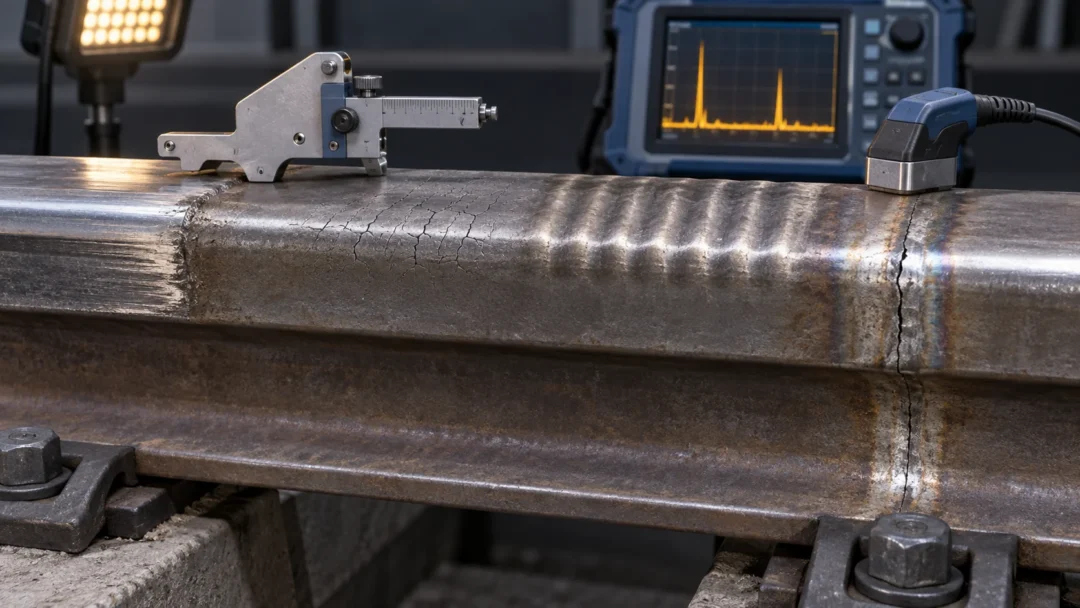
Rail profile measurement and non-destructive testing help determine whether a defect is suitable for grinding, repair or replacement.
Rail-head and gauge-face wear change wheel–rail contact. On a metro line, the first passenger-visible symptoms may be tonal noise or vibration. Maintenance staff may also find a widening contact band, side wear in a tight curve, corrugation, shelling, spalling or plastic flow.
The defect pattern matters more than the label. For example, grinding a corrugated rail can restore a smoother running surface, but the corrugation may return if the underlying wheel–rail dynamics, support condition or vehicle response remain unchanged. Side wear on a small-radius curve can also reflect lubrication, friction management, wheel and rail hardness, or profile compatibility.
Before planning rail grinding, measure:
- Rail profile and remaining wear allowance
- Corrugation wavelength and depth where relevant
- Crack or damaged-layer depth
- Track location, curve radius and rail side
- Contact-band position and adjacent track condition
- Grinding-machine access and required possession time
The objective should be specific: remove a measured damaged layer, restore an approved profile, correct an irregular weld transition or reduce a defined surface condition. “Make the rail look smooth” is not an acceptance criterion.
For a closer look at execution and acceptance, see rail track grinding standards and practical techniques. The broader railway grinding guide explains preventive and corrective grinding strategies.
3. Track Gauge, Twist and Alignment
Gauge widening and track twist affect how the vehicle is supported and guided. Alignment, cross-level and longitudinal-level errors can add dynamic loading even when the rail surface itself looks serviceable.
These conditions should be measured with calibrated track-geometry equipment under the operator's applicable standards. A single value is useful, but trend and location are often more revealing. Repeated geometry loss at the same point may indicate a fastening problem, voided support, settlement, poor drainage or structural movement.
Grinding cannot correct a loose fastening system, slab movement or loss of sleeper support. It may refine the rail profile after the track structure is stable, but it should not hide the mechanism producing the geometry fault.
4. Turnout and Switch Risks
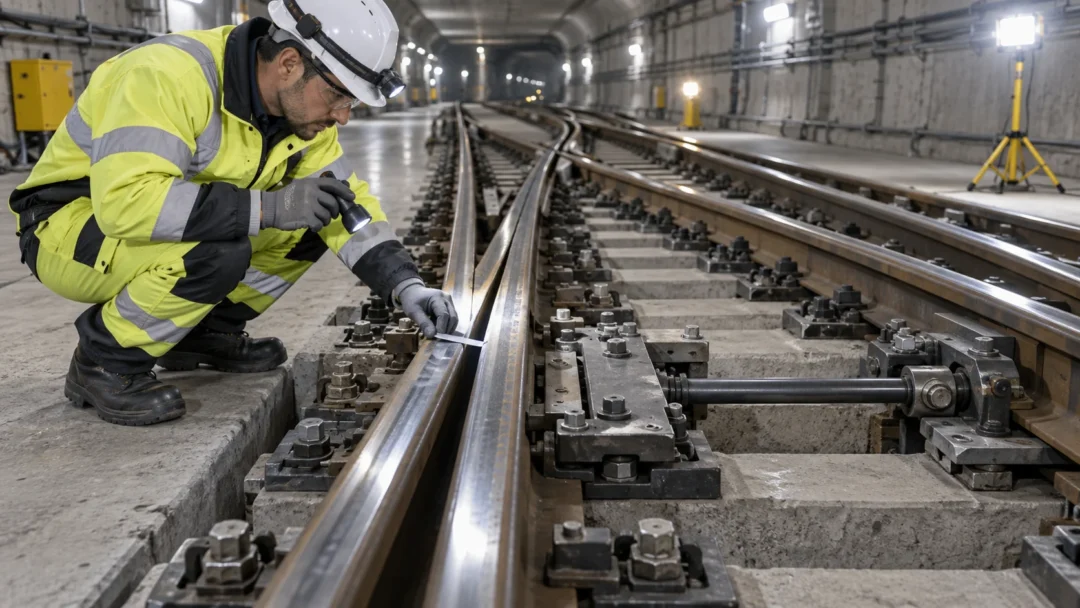
Turnout inspection should cover switch-point fit, running surfaces, fasteners, slide plates and operating components.
Turnouts combine discontinuous rail profiles, moving components, tight tolerances and concentrated wheel loads. Inspection should cover the switch points, stock rails, crossings, guard rails, connecting parts, slide plates, fasteners and operating mechanism—not only the most visibly worn surface. For terminology and component context, see what a railroad frog is and how it functions.
Common warning signs include:
- A switch point that does not fit correctly against the stock rail
- Chipping, cracking or deformation at the switch rail or crossing
- Loose, missing or deformed bolts, rods, plates or fasteners
- Geometry outside the approved limit
- Impact marks, metal flow or an irregular wheel-contact path
- Restricted movement caused by debris, ice, poor lubrication or damaged parts
Profile grinding can remove limited surface damage and restore local running geometry on suitable turnout components. The work needs frequent measurement because access angles are restricted and over-grinding can change the wheel transfer path. A fractured switch point, defective operating component or unacceptable geometry needs mechanical or component repair first.
Portable grinders and their consumables are discussed in the railroad track grinder guide. When selecting a wheel, confirm the machine model, wheel dimensions, mounting, maximum operating speed and required rail application rather than relying on diameter alone.
5. Fasteners, Sleepers and Track-Bed Support
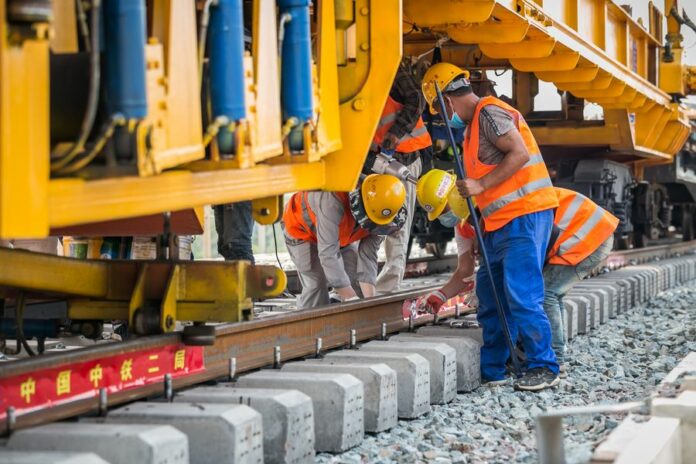
A rail can only hold its intended position when the support system is working. Broken bolts, lifted screw spikes, damaged clips, deformed baseplates and loss of clamping force can permit movement or alter load distribution.
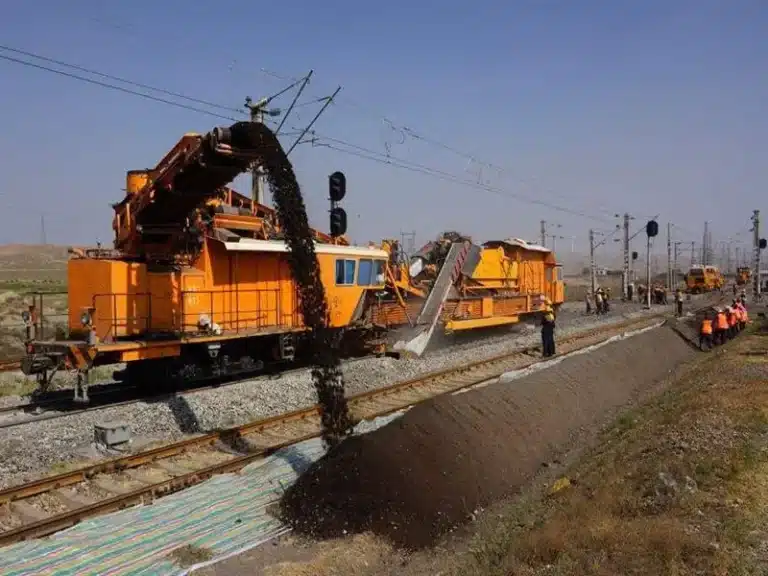
Below the fastening system, inspectors should look for cracked sleepers, hanging or unsupported sleepers, slab-track voids, settlement, uplift, damaged support blocks, loose ballast and mud pumping. Changes in ride quality or repeated local rail defects may point to these support problems. On ballasted sections, the railway ballast maintenance guide explains the support, drainage and upkeep functions of the ballast layer.
The practical sequence is straightforward:
- Protect the operation if the condition exceeds the permitted limit.
- Confirm the defect and its extent with the specified measurement method.
- Repair the fastening, sleeper or support condition.
- Restore track geometry.
- Reassess the rail profile and surface condition.
This sequence prevents a surface treatment from being used where structural support is the real problem.
6. Drainage, Water and Subgrade Risks
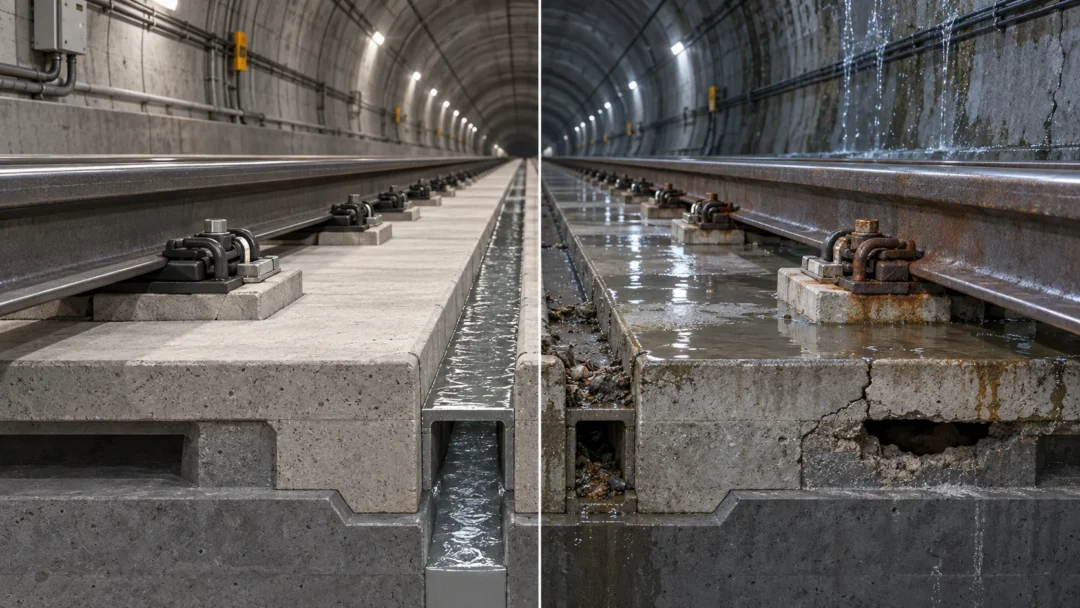
Blocked drainage and repeated leakage can affect fasteners, concrete support and track geometry long after visible water is removed.
Water is a track-maintenance multiplier. Blocked drainage or tunnel leakage can saturate support layers, contribute to mud pumping, corrode components and create electrical or access hazards. At open sections, inadequate surface drainage can erode or saturate the subgrade and destabilize slopes.
Record the water source, affected length, depth or flow condition, weather at the time, and whether the condition changes after pumping or rainfall. Repeated pumping without correcting the source should remain an open risk, not a completed repair.
Track inspections after heavy rain or flooding should check more than standing water. Geometry change, ballast movement, voids, debris, electrical equipment exposure and restricted access may remain after water has receded.
7. Heat, Ice, Debris and Other Environmental Conditions
High rail temperature can raise the risk of track buckling where the track condition or stress management is inadequate. Ice and snow can restrict turnout movement or reduce wheel–rail adhesion. Wind, construction activity and damaged protection barriers can introduce debris into the operating envelope.
Seasonal controls should define trigger conditions, inspection locations, responsible roles and the action to take when limits are reached. A general note saying “inspect during bad weather” is too vague for a working risk register.
How to Build a Metro Track Risk Register
The Ministry of Transport framework requires more than a defect list. It calls for each operator to develop a risk database covering the risk location, risk level, controls, responsible department and responsible role. A practical track entry can use the following fields:
| Field | Example entry |
|---|---|
| Asset and location | Up line, curve, chainage, left rail |
| Risk point | Gauge-face wear and head checks |
| Possible consequence | Poor contact geometry and crack growth |
| Condition evidence | Profile measurement, NDT result, photographs |
| Risk level | Assigned under the operator's approved matrix |
| Existing controls | Inspection interval, temporary limit, lubrication check |
| Planned action | Engineering review, grinding plan or rail replacement |
| Owner and deadline | Named department, responsible role and due date |
| Closure evidence | Post-work measurement and acceptance record |
The governing document divides risks into major, relatively major, general and relatively minor levels based on likelihood and consequence. Operators should apply their approved assessment method instead of copying a risk level from another network.
Metro Track Inspection Checklist
Use this condensed list to structure an inspection. It is not a substitute for the operator's standards or safety procedures.
Rails and welds
- Check for visible cracks, fractures, burns, corrugation, spalling and plastic flow.
- Measure vertical and lateral wear at defined locations.
- Review weld and joint condition, including alignment and movement.
- Compare findings with prior inspection records.
Geometry and fastening
- Measure gauge, twist, alignment and level using the required method.
- Check clips, bolts, baseplates and screw spikes for damage or loss of restraint.
- Investigate repeated geometry loss instead of repeatedly correcting the symptom.
Turnouts
- Confirm switch-point fit and unrestricted movement.
- Check switch rails, stock rails, crossings and guard rails for damage and wear.
- Inspect rods, plates, fasteners and the operating mechanism.
- Verify post-maintenance geometry and functional operation.
Track structure and environment
- Check sleepers, slab track, ballast and support for cracks, voids or settlement.
- Inspect drains, leakage points, subgrade and adjacent slopes.
- Look for debris, damaged barriers and objects entering the operating envelope.
- Apply the operator's heat, flood, snow and ice inspection requirements.
Where Rail Grinding Fits in Risk Control
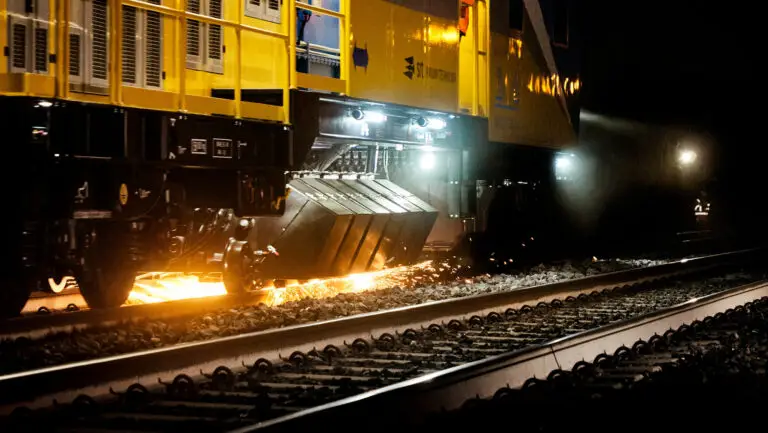
Rail grinding is one tool within a wider maintenance system. It can remove suitable surface defects, manage corrugation, restore a target rail-head profile and improve transitions around repair welds. It should follow inspection and measurement, with post-grinding checks confirming the achieved profile and surface condition.
Grinding is not the right control for every risk. It does not restore failed fasteners, repair unstable support, clear drainage, reset rail stress or make a deep crack safe. Good planning separates grindable defects from conditions requiring welding, fastening work, geometry correction, drainage work or component replacement.
For metro applications, the grinding method also depends on access and asset type. Grinding trains suit longer running-rail sections, while portable profile grinders are used around welds, turnouts and restricted locations. See our guide to metro rail grinding train solutions for the equipment context.
Selecting Grinding Wheels for Metro Maintenance
Wheel selection starts with the machine and task, not with a generic statement such as “for metro rail.” Before requesting a quotation, provide:
- Grinding-machine manufacturer and model
- Current wheel marking, diameter, thickness and bore or thread
- Mounting details and maximum permitted operating speed
- Rail section and the surface or profile to be ground
- Required quantity and destination country
- Required delivery date
This information allows a supplier to check whether a standard wheel is available or whether the application needs engineering confirmation. For turnout and portable-grinder work, review the profile grinding wheel range. For grinding trains, see rail grinding train wheels.
Need to confirm a grinding-wheel match? Send the machine model, current wheel dimensions, mounting details, application, quantity, destination country and required delivery date. Our technical team can review compatibility and prepare a quotation.
Request a Grinding Wheel Quotation
Frequently Asked Questions
What are the main metro rail track maintenance risks?
The main risks include rail fracture, wear, cracked welds, gauge or alignment faults, turnout defects, failed fasteners, damaged sleepers, unstable track-bed support, poor drainage and weather-related track changes. The risk level depends on both the probability of failure and the possible operating consequence.
Can rail grinding prevent rail fractures?
Rail grinding can remove selected surface cracks before they grow deeper, provided testing confirms that grinding is an appropriate treatment and enough sound rail remains. It cannot repair a deep internal defect, a through-crack or a failed weld.
When should metro rails be ground?
There is no single interval for every metro. The decision should use inspection data, rail profile, defect depth, traffic, curve condition, noise or corrugation measurements, and the operator's maintenance limits. Condition-based planning is more defensible than copying a calendar interval from another network.
What should be checked after rail grinding?
Post-grinding inspection should verify the rail profile, remaining defect condition, surface finish and transition to adjacent rail. Turnout work may also require geometry checks and a functional test under the operator's procedure.
Sources
- Ministry of Transport of China: Measures for the Management of Classified Operational Safety Risks and Hidden-Hazard Investigation in Urban Rail Transit
- Ministry of Transport of China: Main Operational Safety Risk Points for Urban Rail Transit (PDF)