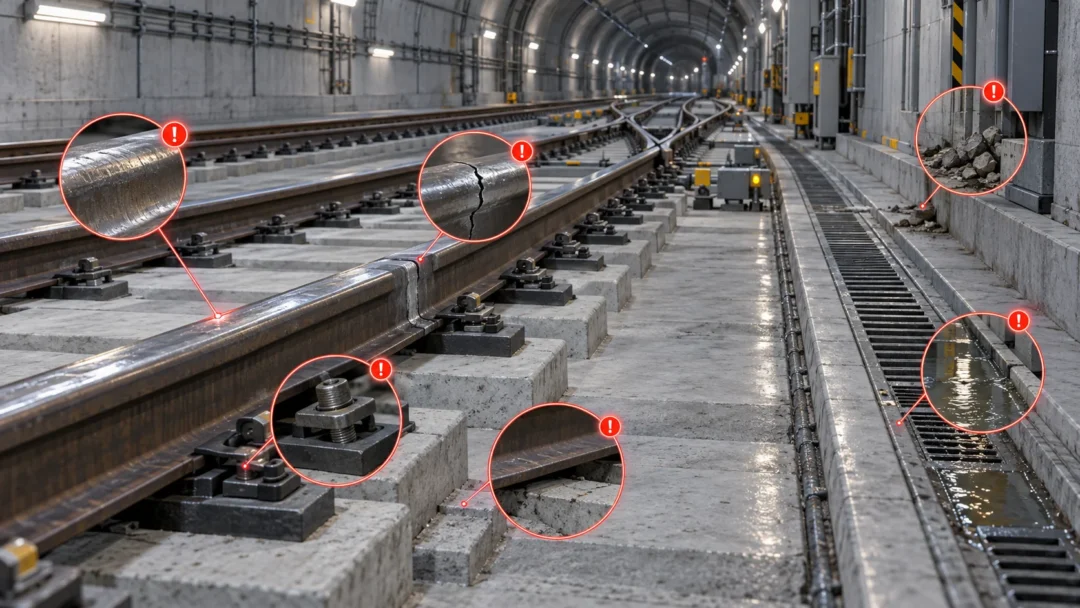
Metro raylı sistemlerinde bakım riskleri arasında kırık veya aşınmış raylar, çatlak kaynaklar, hatalı ray geometrisi, hasarlı bağlantı elemanları, makas kusurları, desteksiz traversler, bozulmuş ray yatakları, drenaj arızaları ve hava koşullarına bağlı değişiklikler yer almaktadır. Etkili bir denetim programı, her bir kusuru olası işletme sonuçlarıyla ilişkilendirir ve ardından ölçülen duruma göre izleme, onarım, taşlama veya parça değişimi seçeneklerinden birini belirler.
Bu kılavuz, demiryolu altyapısına odaklanmaktadır. Çin Ulaştırma Bakanlığı’nın 2024 yılında yayınladığı risk kategorilerinden yararlanmaktadır. Kentsel Raylı Ulaşımda Gizli Kaldırılan Operasyonel Güvenlik Risklerinin Yönetimi ve Gizli Tehlikelerin Araştırılmasına Yönelik Önlemler. Bu kaynak, operatörlerin riskleri belirlemelerini, risk düzeylerini değerlendirmelerini, kontrol önlemlerini tanımlamalarını ve bir risk veritabanı tutmalarını gerektirmektedir. Tek bir evrensel bakım aralığı veya onarım yöntemi öngörmemektedir.
Hızlı Risk Haritası
| Pist alanı | Tipik uyarı belirtileri | Temel faaliyet sorunu | Tipik bakım müdahalesi |
|---|---|---|---|
| Raylar ve kaynaklar | Çatlaklar, aşınma, oluklanma, dökülme, derz hareketi | Titreşim, gürültü, geometri bozulması veya ray arızası | Ölçün, test edin, uygunsa taşlayın, kaynakla onarın veya değiştirin |
| Hat geometrisi | Ray aralığı genişlemesi, bükülme, hizalama veya seviye sapması | Aracın tepki süresinin uzaması ve raydan çıkma riskinin artması | Geometrik ölçüm, sabitleme ve destek düzeltmesi, sıkıştırma veya döşeme onarımı |
| Mafsallar | Anahtar noktalarının kötü oturması, hasarlı bağlantı elemanları, aşınmış sürtünme yüzeyleri | Yanlış yönlendirme, darbe yüklemesi veya makas hasarı | Geometriyi ve mekanizmaları inceleyin, bileşenleri onarın, gerektiğinde profil taşlaması yapın |
| Rayı ve ray yatağı | Çatlaklar, boşluklar, oturma, çamur pompalama | Azalan destek ve artan dinamik yükler | Destek, drenaj ve geometriyi eski haline getirin; arızalı bileşenleri değiştirin |
| Drenaj ve çevre | Durgun su, sızıntı, ısı, buz veya kalıntılar | Hareket, korozyon, yetersiz yapışma veya tıkanıklığı takip edin | Acil tehlikeyi ortadan kaldırın, drenajı yeniden sağlayın, mevsimsel denetim sıklığını artırın |
Müdahale seçenekleri kasıtlı olarak geniş tutulmuştur. Bakım ekipleri, bir müdahaleye karar vermeden önce yine de kusur ölçümlerine, yerel standartlara, trafik koşullarına ve mühendislik onayına ihtiyaç duymaktadır.
Metro Hattı Riski Neden Farklıdır?
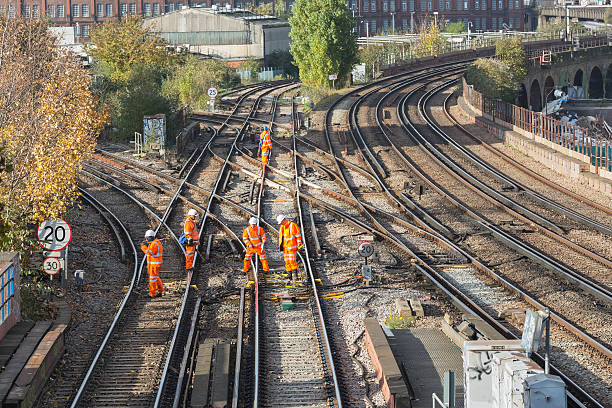
Metro altyapısı çalışmaları, kısıtlı çalışma süreleri içinde gerçekleştirilir. Virajlar keskin olabilir, sefer sıklığı yüksektir, tüneller erişimi kısıtlar ve bakım çalışmaları genellikle gece saatlerinde kısa süreli kullanım izinleri kapsamında yapılır. Gözle yapılan denetim sırasında önemsiz görünen bir kusur, tekrarlanan tekerlek yükleri altında hızla gelişebilir.
Risk, varlık sınırlarını da aşar. Bir tünelden sızan su, bağlantı elemanlarını, yalıtımlı derzleri, ray yatağını ve elektrikli ekipmanı etkileyebilir. Yeterince desteklenmemiş bir travers, tekerlek-ray yüklemesini değiştirir. Bu yükleme ise oluk oluşumunu, bağlantı elemanlarının gevşemesini veya rayda yerel hasarları hızlandırabilir. Daha kapsamlı bir planlama çerçevesi için, kılavuzumuzda farklı türlerde demiryolu hattı bakımı rutin, önleyici, düzeltici ve acil durum çalışmalarını birbirinden ayırır.
Bu nedenle, kusurların listesi yalnızca bir başlangıç noktasıdır. Denetim kaydı, kusurun nerede olduğunu, nasıl değiştiğini, ne gibi sonuçlar doğurabileceğini ve kalıcı onarım yapılana kadar hangi kontrol önlemlerinin yürürlükte kalacağını göstermelidir.
1. Ray Kırıkları ve Kaynak Kusurları
Ray kırılması, en belirgin ve ciddi sonuçlara yol açan demiryolu risklerinden biridir. Bu durumun tetikleyici nedeni, iç yorgunluk, hasarlı bir kaynak, cıvatalı bağlantı kusuru, darbe hasarı veya çıkarılabilir tabakanın altına yayılmış bir yüzey çatlağı olabilir.
Sadece gözle incelemeyle çatlak derinliği belirlenemez. Metro bakım programlarında genellikle gözle incelemeler, uygun tahribatsız muayene yöntemleri ve geometri veya profil ölçümleriyle birleştirilir. Seçilen yöntem, kusurun bulunduğu yer ve rayın durumuna uygun olmalıdır.
Kaydedilmesi gereken başlıca kalemler şunlardır:
- Kusurun zincir mesafesi ve demiryolu kesitindeki konumu
- İster kaynak, birleştirme, delme ister önceki bir onarımla ilgili olsun
- Görünen uzunluk ve yön
- Test sonucu ve bir önceki denetimden bu yana meydana gelen değişiklikler
- Her türlü geçici hız sınırlaması veya izleme şartı
Yeterli miktarda sağlam ray kaldığı ve kaldırma planı onaylanmış ray profili ile aşınma sınırları içinde kaldığı durumlarda, taşlama belirli yüzey kusurları için uygun bir yöntemdir. Bu yöntem, boydan boya çatlaklar, derin iç kusurlar veya arızalı kaynaklar için bir onarım yöntemi değildir. Bu tür durumlarda acil koruma önlemleri alınması, mühendislik incelemesi yapılması ve ray veya kaynağın değiştirilmesi gerekebilir. Takip yöntemleri için lütfen farklı demiryolu kaynak türleri. Durum, acil koruma ve hizmetin yeniden sağlanmasına yönelik planlama gerektirdiğinde, şunu kullanın: acil durum ray onarım protokolü.
2. Ray Aşınması, Oluklanma ve Yüzey Hasarı
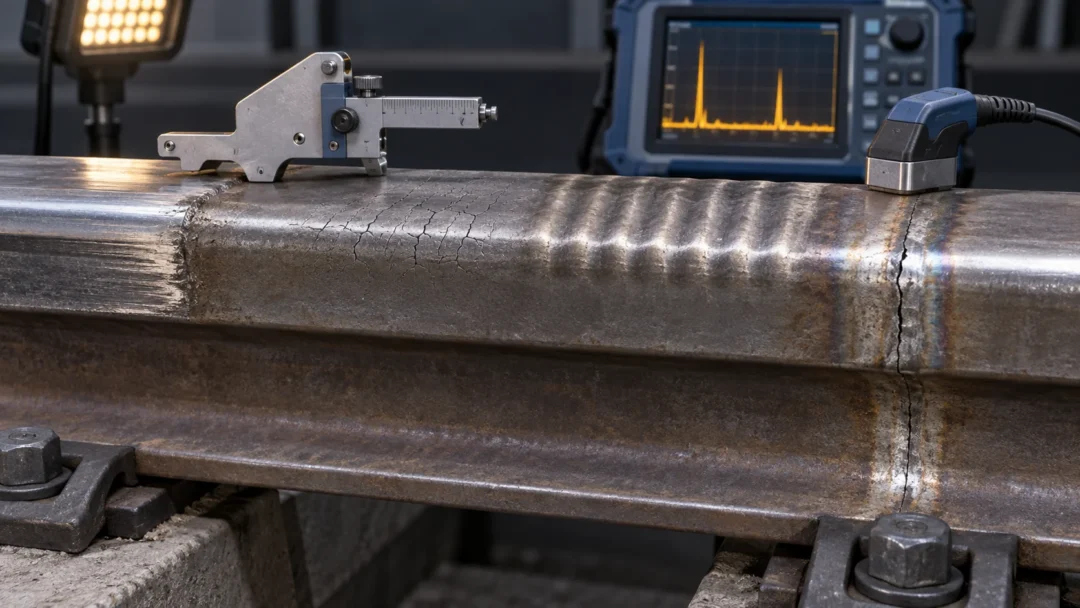
Ray profil ölçümü ve tahribatsız muayene, bir kusurun taşlama, onarım veya değiştirme işlemlerine uygun olup olmadığının belirlenmesine yardımcı olur.
Ray başı ve ray yüzeyindeki aşınma, tekerlek-ray temasını değiştirir. Bir metro hattında, yolcuların fark edebileceği ilk belirtiler tonlu gürültü veya titreşim olabilir. Bakım personeli ayrıca temas şeridinin genişlemesini, dar virajlarda yan aşınmayı, oluklanmayı, kabuklanmayı, parçalanmayı veya plastik akışı tespit edebilir.
The defect pattern matters more than the label. For example, grinding a corrugated rail can restore a smoother running surface, but the corrugation may return if the underlying wheel–rail dynamics, support condition or vehicle response remain unchanged. Side wear on a small-radius curve can also reflect lubrication, friction management, wheel and rail hardness, or profile compatibility.
Before planning rail grinding, measure:
- Rail profile and remaining wear allowance
- Corrugation wavelength and depth where relevant
- Crack or damaged-layer depth
- Track location, curve radius and rail side
- Contact-band position and adjacent track condition
- Grinding-machine access and required possession time
The objective should be specific: remove a measured damaged layer, restore an approved profile, correct an irregular weld transition or reduce a defined surface condition. “Make the rail look smooth” is not an acceptance criterion.
For a closer look at execution and acceptance, see demiryolu ray taşlama standartları ve uygulamalı teknikler. The broader railway grinding guide explains preventive and corrective grinding strategies.
3. Track Gauge, Twist and Alignment
Gauge widening and track twist affect how the vehicle is supported and guided. Alignment, cross-level and longitudinal-level errors can add dynamic loading even when the rail surface itself looks serviceable.
These conditions should be measured with calibrated track-geometry equipment under the operator's applicable standards. A single value is useful, but trend and location are often more revealing. Repeated geometry loss at the same point may indicate a fastening problem, voided support, settlement, poor drainage or structural movement.
Grinding cannot correct a loose fastening system, slab movement or loss of sleeper support. It may refine the rail profile after the track structure is stable, but it should not hide the mechanism producing the geometry fault.
4. Turnout and Switch Risks
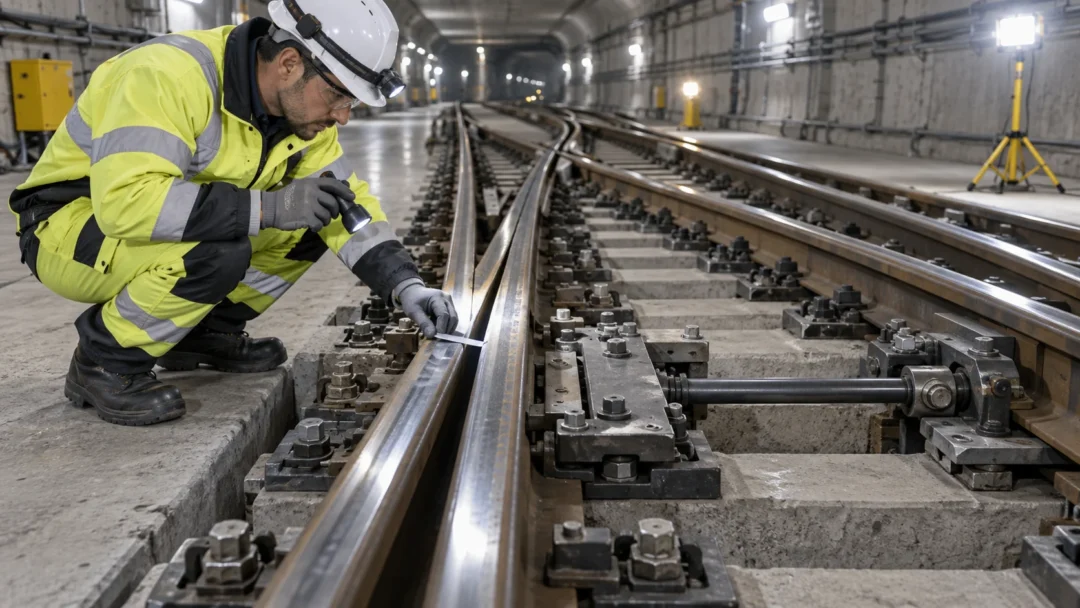
Turnout inspection should cover switch-point fit, running surfaces, fasteners, slide plates and operating components.
Turnouts combine discontinuous rail profiles, moving components, tight tolerances and concentrated wheel loads. Inspection should cover the switch points, stock rails, crossings, guard rails, connecting parts, slide plates, fasteners and operating mechanism—not only the most visibly worn surface. For terminology and component context, see what a railroad frog is and how it functions.
Common warning signs include:
- A switch point that does not fit correctly against the stock rail
- Chipping, cracking or deformation at the switch rail or crossing
- Loose, missing or deformed bolts, rods, plates or fasteners
- Geometry outside the approved limit
- Impact marks, metal flow or an irregular wheel-contact path
- Restricted movement caused by debris, ice, poor lubrication or damaged parts
Profile grinding can remove limited surface damage and restore local running geometry on suitable turnout components. The work needs frequent measurement because access angles are restricted and over-grinding can change the wheel transfer path. A fractured switch point, defective operating component or unacceptable geometry needs mechanical or component repair first.
Portable grinders and their consumables are discussed in the railroad track grinder guide. When selecting a wheel, confirm the machine model, wheel dimensions, mounting, maximum operating speed and required rail application rather than relying on diameter alone.
5. Fasteners, Sleepers and Track-Bed Support
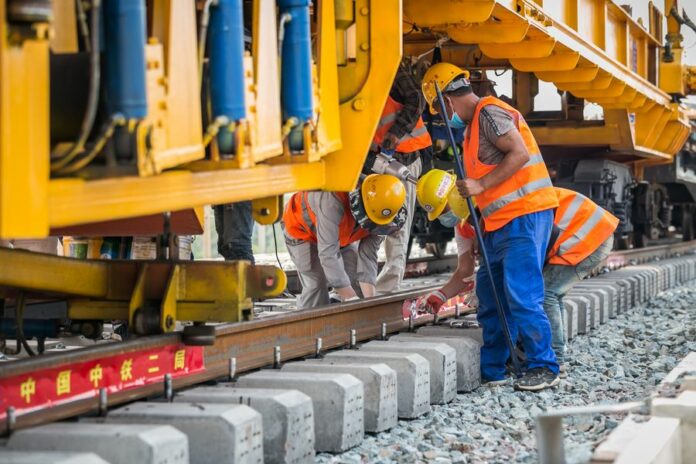
A rail can only hold its intended position when the support system is working. Broken bolts, lifted screw spikes, damaged clips, deformed baseplates and loss of clamping force can permit movement or alter load distribution.
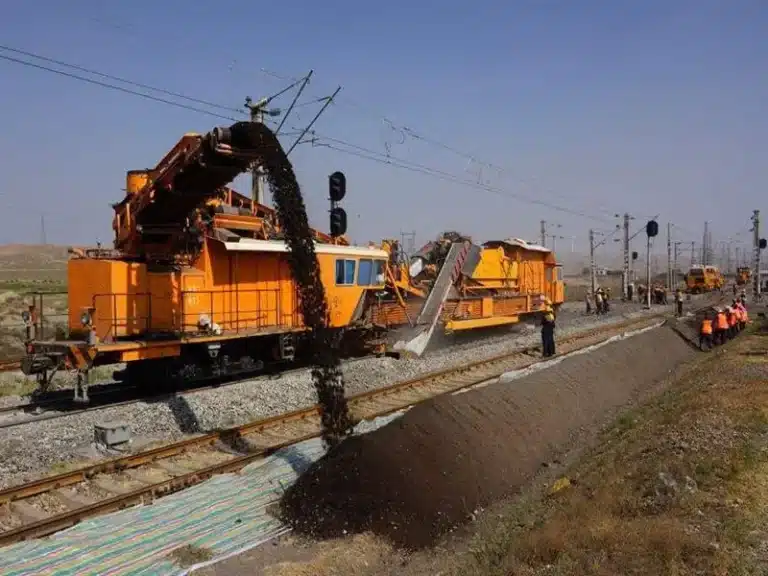
Below the fastening system, inspectors should look for cracked sleepers, hanging or unsupported sleepers, slab-track voids, settlement, uplift, damaged support blocks, loose ballast and mud pumping. Changes in ride quality or repeated local rail defects may point to these support problems. On ballasted sections, the railway ballast maintenance guide explains the support, drainage and upkeep functions of the ballast layer.
The practical sequence is straightforward:
- Protect the operation if the condition exceeds the permitted limit.
- Confirm the defect and its extent with the specified measurement method.
- Repair the fastening, sleeper or support condition.
- Restore track geometry.
- Reassess the rail profile and surface condition.
This sequence prevents a surface treatment from being used where structural support is the real problem.
6. Drainage, Water and Subgrade Risks
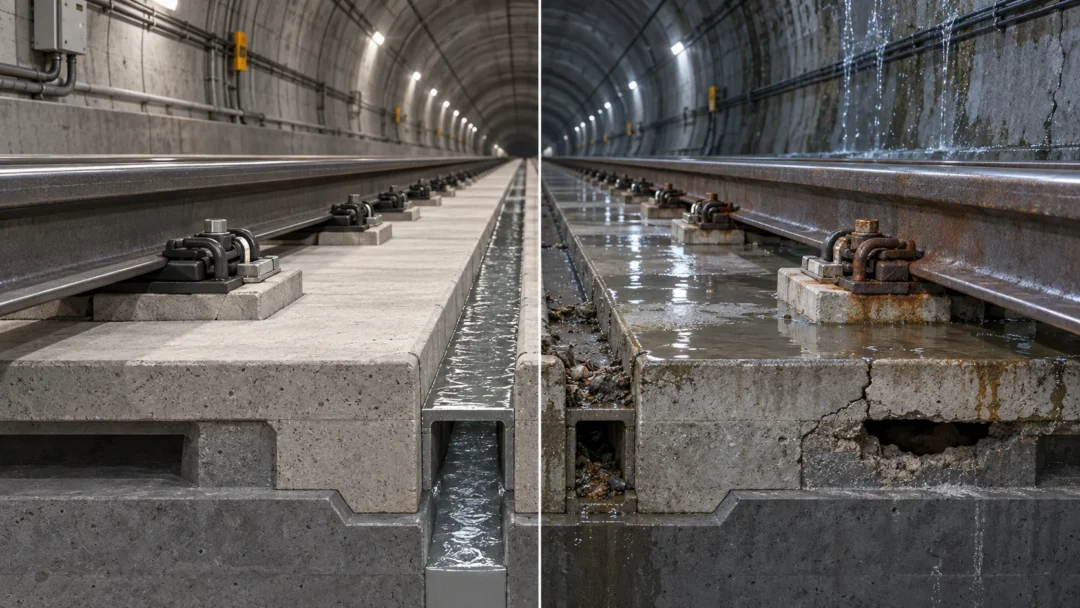
Blocked drainage and repeated leakage can affect fasteners, concrete support and track geometry long after visible water is removed.
Water is a track-maintenance multiplier. Blocked drainage or tunnel leakage can saturate support layers, contribute to mud pumping, corrode components and create electrical or access hazards. At open sections, inadequate surface drainage can erode or saturate the subgrade and destabilize slopes.
Record the water source, affected length, depth or flow condition, weather at the time, and whether the condition changes after pumping or rainfall. Repeated pumping without correcting the source should remain an open risk, not a completed repair.
Track inspections after heavy rain or flooding should check more than standing water. Geometry change, ballast movement, voids, debris, electrical equipment exposure and restricted access may remain after water has receded.
7. Heat, Ice, Debris and Other Environmental Conditions
High rail temperature can raise the risk of track buckling where the track condition or stress management is inadequate. Ice and snow can restrict turnout movement or reduce wheel–rail adhesion. Wind, construction activity and damaged protection barriers can introduce debris into the operating envelope.
Seasonal controls should define trigger conditions, inspection locations, responsible roles and the action to take when limits are reached. A general note saying “inspect during bad weather” is too vague for a working risk register.
How to Build a Metro Track Risk Register
The Ministry of Transport framework requires more than a defect list. It calls for each operator to develop a risk database covering the risk location, risk level, controls, responsible department and responsible role. A practical track entry can use the following fields:
| Field | Example entry |
|---|---|
| Asset and location | Up line, curve, chainage, left rail |
| Risk point | Gauge-face wear and head checks |
| Possible consequence | Poor contact geometry and crack growth |
| Condition evidence | Profile measurement, NDT result, photographs |
| Risk level | Assigned under the operator's approved matrix |
| Existing controls | Inspection interval, temporary limit, lubrication check |
| Planned action | Engineering review, grinding plan or rail replacement |
| Owner and deadline | Named department, responsible role and due date |
| Closure evidence | Post-work measurement and acceptance record |
The governing document divides risks into major, relatively major, general and relatively minor levels based on likelihood and consequence. Operators should apply their approved assessment method instead of copying a risk level from another network.
Metro Track Inspection Checklist
Use this condensed list to structure an inspection. It is not a substitute for the operator's standards or safety procedures.
Rails and welds
- Check for visible cracks, fractures, burns, corrugation, spalling and plastic flow.
- Measure vertical and lateral wear at defined locations.
- Review weld and joint condition, including alignment and movement.
- Compare findings with prior inspection records.
Geometry and fastening
- Measure gauge, twist, alignment and level using the required method.
- Check clips, bolts, baseplates and screw spikes for damage or loss of restraint.
- Investigate repeated geometry loss instead of repeatedly correcting the symptom.
Mafsallar
- Confirm switch-point fit and unrestricted movement.
- Check switch rails, stock rails, crossings and guard rails for damage and wear.
- Inspect rods, plates, fasteners and the operating mechanism.
- Verify post-maintenance geometry and functional operation.
Track structure and environment
- Check sleepers, slab track, ballast and support for cracks, voids or settlement.
- Inspect drains, leakage points, subgrade and adjacent slopes.
- Look for debris, damaged barriers and objects entering the operating envelope.
- Apply the operator's heat, flood, snow and ice inspection requirements.
Where Rail Grinding Fits in Risk Control
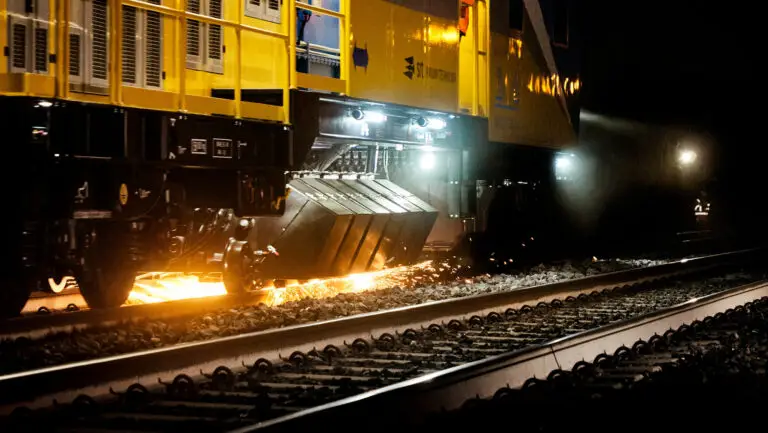
Rail grinding is one tool within a wider maintenance system. It can remove suitable surface defects, manage corrugation, restore a target rail-head profile and improve transitions around repair welds. It should follow inspection and measurement, with post-grinding checks confirming the achieved profile and surface condition.
Grinding is not the right control for every risk. It does not restore failed fasteners, repair unstable support, clear drainage, reset rail stress or make a deep crack safe. Good planning separates grindable defects from conditions requiring welding, fastening work, geometry correction, drainage work or component replacement.
For metro applications, the grinding method also depends on access and asset type. Grinding trains suit longer running-rail sections, while portable profile grinders are used around welds, turnouts and restricted locations. See our guide to metro rail grinding train solutions for the equipment context.
Selecting Grinding Wheels for Metro Maintenance
Wheel selection starts with the machine and task, not with a generic statement such as “for metro rail.” Before requesting a quotation, provide:
- Grinding-machine manufacturer and model
- Current wheel marking, diameter, thickness and bore or thread
- Mounting details and maximum permitted operating speed
- Rail section and the surface or profile to be ground
- Required quantity and destination country
- Required delivery date
This information allows a supplier to check whether a standard wheel is available or whether the application needs engineering confirmation. For turnout and portable-grinder work, review the profile grinding wheel range. For grinding trains, see demiryolu tren tekerleklerinin taşlanması.
Need to confirm a grinding-wheel match? Send the machine model, current wheel dimensions, mounting details, application, quantity, destination country and required delivery date. Our technical team can review compatibility and prepare a quotation.
Request a Grinding Wheel Quotation
Sık Sorulan Sorular
What are the main metro rail track maintenance risks?
The main risks include rail fracture, wear, cracked welds, gauge or alignment faults, turnout defects, failed fasteners, damaged sleepers, unstable track-bed support, poor drainage and weather-related track changes. The risk level depends on both the probability of failure and the possible operating consequence.
Can rail grinding prevent rail fractures?
Rail grinding can remove selected surface cracks before they grow deeper, provided testing confirms that grinding is an appropriate treatment and enough sound rail remains. It cannot repair a deep internal defect, a through-crack or a failed weld.
When should metro rails be ground?
There is no single interval for every metro. The decision should use inspection data, rail profile, defect depth, traffic, curve condition, noise or corrugation measurements, and the operator's maintenance limits. Condition-based planning is more defensible than copying a calendar interval from another network.
What should be checked after rail grinding?
Post-grinding inspection should verify the rail profile, remaining defect condition, surface finish and transition to adjacent rail. Turnout work may also require geometry checks and a functional test under the operator's procedure.
Sources
- Ministry of Transport of China: Measures for the Management of Classified Operational Safety Risks and Hidden-Hazard Investigation in Urban Rail Transit
- Ministry of Transport of China: Main Operational Safety Risk Points for Urban Rail Transit (PDF)