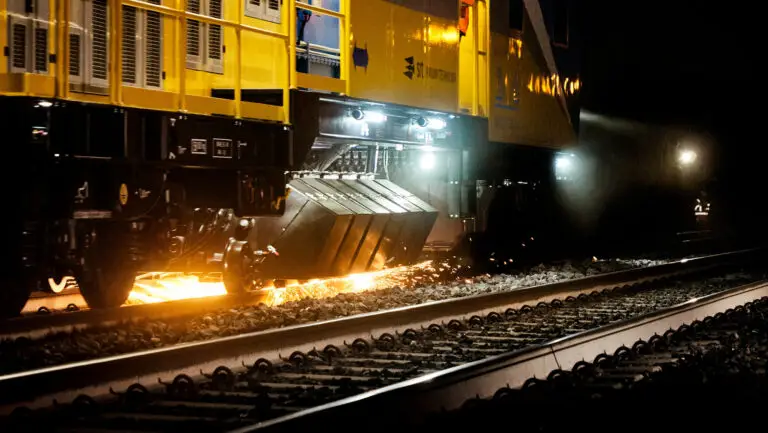
Grinding burn is a thermal defect that occurs when the railhead surface overheats during grinding or weld finishing. The friction heat rapidly raises the surface temperature above the steel’s transformation threshold, changing the microstructure of the rail surface, discoloring it through oxidation, and — in severe cases — leaving micro-cracks that can develop into fatigue failures.
Because grinding is performed precisely to extend rail life, grinding burn is one of the most serious quality failures a grinding campaign can produce. This guide explains how grinding burn forms, how it is detected and judged under international standards, and — most importantly for maintenance planners and contractors — how correct grinding wheel selection and process control prevent it.
Quick Answer
Grinding burn is heat damage to the railhead surface caused by excessive grinding temperature — typically from too much wheel pressure, too deep a cut, too long a dwell, or a wheel grade that is too hard. It appears as straw-to-blue oxidation colors, and it changes the rail’s microstructure: a softened temper zone or a brittle re-hardened “white layer,” sometimes with micro-cracks. It is detected by visual color checks, acid etching, metallography, hardness testing, or Barkhausen noise analysis, and standards such as EN 13231-2:2020 do not accept it on the finished rail. The most effective prevention is a correctly specified grinding wheel combined with light, non-stop passes.
What Is Grinding Burn?
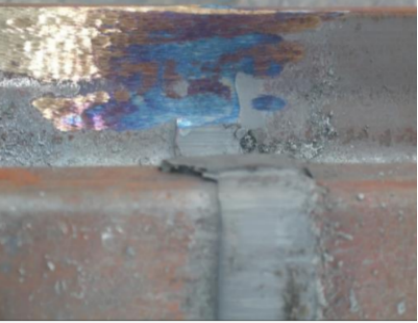
Grinding burn is a group of thermally induced surface alterations caused by excessive heat input during abrasive grinding. Depending on the peak temperature reached at the railhead surface, two distinct forms occur:
| Form | Surface temperature | What happens | Typical appearance |
|---|---|---|---|
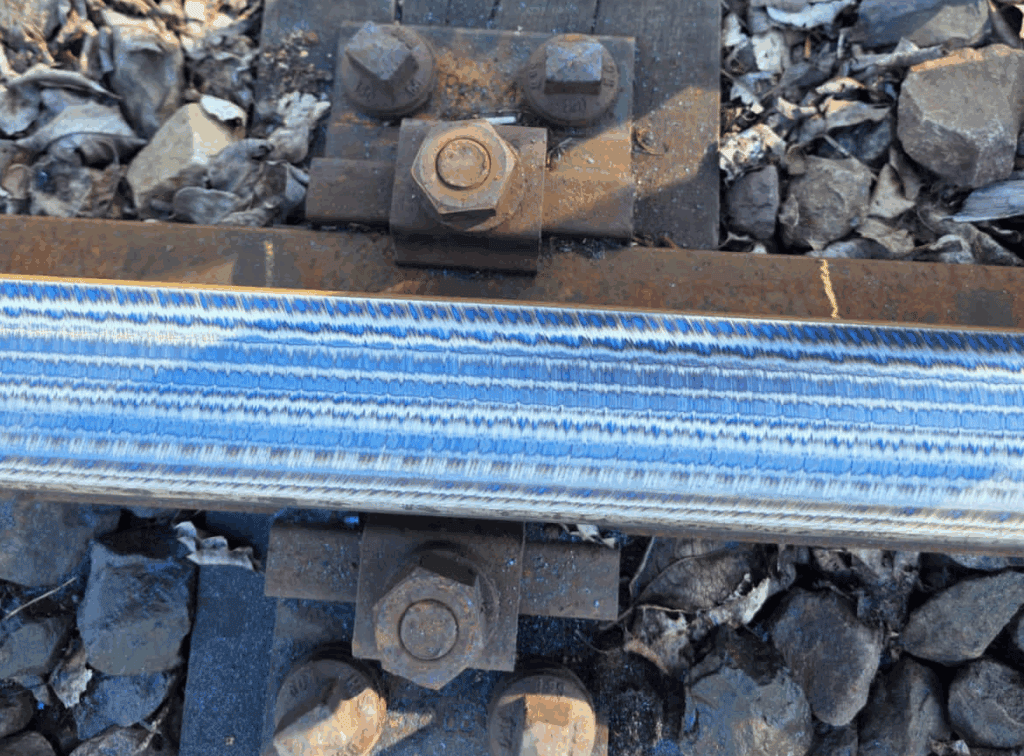
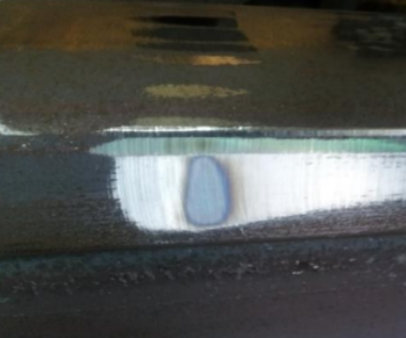
| Tempering (softening) burn | Below the austenitizing temperature (~720 °C for pearlitic rail steel) | The hardened surface layer is tempered; hardness and wear resistance decrease | Straw → purple → blue → blue-black oxidation colors, depending on peak temperature and oxide film thickness |
| Re-hardening burn | Above the austenitizing temperature, followed by rapid self-quenching | A thin, brittle untempered martensite layer (“white layer”) forms on the surface | Light or uncolored surface with a hard white layer; prone to micro-cracking |
For visual on-site judgment, the oxide (temper) colors give a rough indication of the peak surface temperature reached — approximate values for pearlitic rail steel:
| Temper color | Approximate peak surface temperature |
|---|---|
| Light straw | ~220 °C |
| Dark straw / brown | ~250 °C |
| Purple | ~280 °C |
| Blue | ~300–320 °C |
| Blue-black / grey | above ~330 °C |
The severity of re-hardening burn is measurable in hardness terms: while standard pearlitic rail steel typically sits around 300–380 HV, the untempered martensite “white layer” is commonly reported in the range of roughly 600–800 HV — hard, but brittle, and unsupported by the tough microstructure underneath. Burned layers are thin — typically from a few hundredths to a few tenths of a millimetre — which is why shallow burn can sometimes be removed by re-grinding, while deeper burn requires rail replacement.
Both forms damage the rail. Tempered zones wear faster; re-hardened zones are brittle and crack under cyclic wheel loads. Severe grinding burn is usually accompanied by micro-cracks at the surface, which act as initiation points for rolling contact fatigue (RCF), spalling, and — at weld joints — premature weld failure.
Key point: Grinding burn is not a cosmetic issue. The blue or blue-black discoloration is only the visible evidence of a microstructural change underneath, which is why acceptance standards treat it as a rejectable defect.
Why Grinding Burn Matters
- Accelerated wear: softened (tempered) areas lose hardness and wear several times faster than the surrounding rail.
- Fatigue initiation: re-hardened martensite and micro-cracks initiate head checks, spalling and squats under traffic.
- Weld integrity: on flash-butt and thermite welds, burn on the weld or its vicinity defeats the fatigue design of the joint.
- Rework cost: burned rails must be re-ground deeper or, when burn is deep, cut out and re-welded — expensive remedial work that a correct grinding process avoids.
What Causes Grinding Burn?
Grinding burn always comes down to one mechanism — heat generated faster than it can be dissipated — but five common operational causes trigger it:
- Excessive grinding pressure or dwell time. Pressing the wheel too hard, or holding it on one spot for too long, concentrates heat in a small zone.
- Excessive depth of cut per pass. Trying to remove too much metal in a single pass multiplies friction energy. Preventive passes should remove small, controlled amounts of metal.
- Wheel hardness too high for the application. A wheel grade that is too hard does not release dull abrasive grains; the glazed wheel rubs instead of cutting, and rubbing generates heat rather than metal removal.
- Unsuitable abrasive or bond. Grit size, abrasive type, and bond formulation that do not match the rail steel and machine parameters increase specific grinding energy.
- Poor heat management. Grinding without coolant or dust-suppression water, high wheel peripheral speed, or long continuous grinding on one location prevents the heat from dissipating.
The first three causes are directly controllable through grinding wheel selection and process discipline — which is why wheel specification is a technical decision, not a purchasing formality.
How Grinding Burn Is Detected
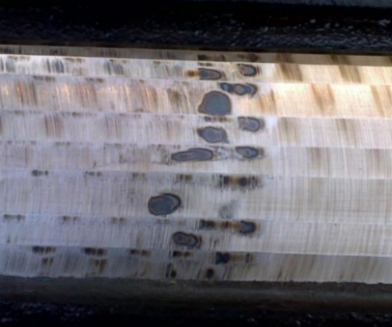
Rail maintenance organizations use five inspection methods, from quick visual checks to laboratory analysis:
| # | Method | Principle | Best for | Limitation |
|---|---|---|---|---|
| 1 | Visual inspection (temper-color check) | Oxide film color and thickness correlate with peak surface temperature | Fast screening of every pass, both on grinding trains and hand finishing | Only shows burn where oxidation colors are visible; light re-hardening burn can be missed |
| 2 | Acid etching | Etching the ground surface with a prepared acid solution reveals thermally altered zones by color change | Reliable workshop-level confirmation on weld joints | Requires surface access, chemicals, and cleaning |
| 3 | Metallographic examination | Microstructure of a surface sample shows the tempered or re-hardened layer and its depth | Definitive laboratory diagnosis and depth measurement | Destructive / lab-based; not for routine field use |
| 4 | Hardness testing | Burn changes surface hardness — softening after tempering, hardening after re-hardening | Quantitative verification of suspect areas | Point measurement; needs calibration against base rail hardness |
| 5 | Magnetic Barkhausen noise analysis | Thermal damage and residual stress alter the magnetic domain structure of the rail steel; the Barkhausen signal changes accordingly | Rapid, non-contact screening of long sections by measuring cars and hand probes | Requires instrumented equipment and trained interpretation |
In practice, grinding crews use visual inspection continuously during work — an experienced operator stops and corrects as soon as “bluing” appears — while acid etching and hardness checks are used at weld finishing, and Barkhausen-based systems are increasingly fitted to measurement and grinding trains for objective documentation.
Grinding Burn Acceptance Criteria: EN 13231-2, TB/T and AREMA
- EN 13231-2:2020 — Railway applications — Track — Acceptance of works — Part 2: Acceptance of reprofiling rails in plain line, switches, crossings and expansion devices (successor to EN 13231-3) — sets the visual acceptance criteria for reprofiled rails in Europe. Thermally damaged, burned areas are not acceptable on the finished surface.
- TB/T 1632.1-2014 (Chinese standard for rail welding, Part 1: General technical conditions) requires that the rail surface on and around a welded joint shall be free of grinding burn.
- TB/T 2344.1-2020 (43 kg/m–75 kg/m rails) requires harmful surface defects to be repaired by grinding, with the repair performed so that the rail’s microstructure is not compromised.
- AREMA recommended practices in North America likewise treat thermal damage from grinding as a defect to be avoided through controlled material removal.
The common thread across all standards: the finished rail surface must show no thermal damage, and where burn is found, it must be ground out completely — or, when it is too deep, the rail must be cut and re-welded.
How to Prevent Grinding Burn
Prevention is a combination of machine discipline and correct consumable selection.
1. Control the grinding parameters
- Keep the depth of cut small — preventive grinding removes fractions of a millimetre across multiple passes rather than deep single passes.
- Never dwell on one spot; keep the wheel or train moving at the planned working speed.
- Distribute the grinding pattern across the railhead instead of concentrating passes on a single zone.
- Avoid impact loading; let the wheel cut, not shock.
2. Manage heat
- Use water spray or coolant where the machine is equipped for it.
- In normal-temperature conditions, aim for no visible bluing at all; a correctly set preventive pass should finish cold or barely warm.
- Limit continuous grinding time on one location and allow the surface to cool.
3. Select the correct grinding wheel
This is where most grinding burn problems are actually won or lost:
- Grade (hardness): choose a wheel grade that self-sharpens under the machine’s pressure — dull grains must be shed so fresh abrasive keeps cutting. A grade that is too hard glazes and burns the rail; a grade that is too soft wears out uneconomically.
- Abrasive type: high-performance grains such as zirconia alumina cut cooler and stay sharper far longer than conventional fused aluminas, reducing heat input per millimetre of metal removed.
- Grit size: coarser grits cut fast and cool for heavy corrective work; finer grits produce the final finish on preventive passes.
- Bond and reinforcement: resin bonds with glass-fibre reinforcement provide the safety margin required for grinding-train speeds and give consistent cutting behaviour over the wheel’s life.
- Wheel speed: respect the wheel’s maximum operating speed and the machine’s spindle speed — overspeeding multiplies heat and is a safety risk.
For grinding trains and profile grinders, matching the wheel to the machine family and duty is essential — see our guides on 轨道打磨标准与实用技术 以及 railway grinding process and equipment, or 联系我们 for wheel recommendations matched to your machine — from 260×90×154 grinding train wheels for Harsco PGM and CRRC GMC fleets to M20-mounted profile grinder wheels.
Key Takeaways
- Grinding burn is a thermal microstructural defect — blue/black discoloration signals a softened or re-hardened surface layer, sometimes with micro-cracks.
- It is detected by visual temper colors, acid etching, metallography, hardness testing, and Barkhausen analysis — visual checks are the first line of defense during every pass.
- International standards (EN 13231-2:2020, TB/T 1632.1-2014, TB/T 2344.1-2020) do not accept thermal damage on the finished rail surface.
- The main causes — excessive pressure, dwell time, depth of cut, and wrong wheel hardness — are all controllable through correct process settings and correct grinding wheel selection.
常见问题解答
At what temperature does grinding burn occur on rails?
Visible temper colors start once the railhead surface exceeds roughly 200–220 °C (light straw). Blue discoloration indicates approximately 300–320 °C, and above about 720 °C the steel austenitizes and re-hardens into brittle martensite on self-quenching — the most damaging form of burn.
How deep is a typical grinding burn layer?
Burned layers are thin — typically from a few hundredths to a few tenths of a millimetre. Shallow burn within the allowable metal-removal tolerance can be eliminated by careful re-grinding; deeper burn with micro-cracks requires cutting out and re-welding the affected rail section.
Can bluing on a rail always be removed by re-grinding?
Only if the burned layer is shallow enough that complete removal does not compromise the rail profile or exceed the allowable metal removal. Deep burn — especially with micro-cracks — requires cutting out the affected section and re-welding.
Does grinding burn only happen with hand-held grinders?
No. Hand finishing at welds is a common location, but grinding trains produce burn too when pass depth, pressure, or wheel specification is wrong. Machine grinding in fact offers better control once the correct wheel and pattern are set.
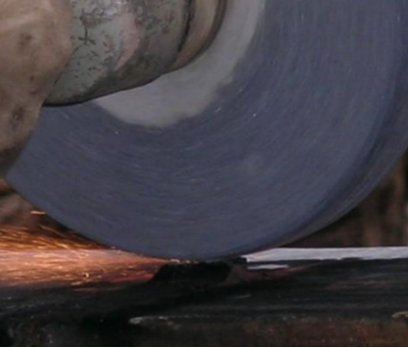
Why does a too-hard wheel cause burn?
A hard-grade wheel retains dull abrasive grains and glazes over. A glazed wheel rubs the rail instead of cutting it, converting grinding energy into heat instead of metal removal — the classic recipe for tempering burn.
参考文献
- EN 13231-2:2020 — Railway applications — Track — Acceptance of works — Part 2: Acceptance of reprofiling rails in plain line, switches, crossings and expansion devices (CEN).
- TB/T 1632.1-2014 — Rail welding — Part 1: General technical conditions (China State Railway Administration).
- TB/T 2344.1-2020 — Rails — Part 1: 43 kg/m–75 kg/m rails (China State Railway Administration).
- AREMA — Manual for Railway Engineering, Chapter 5 — Railroad Track (recommended practices for rail grinding and thermal damage limits).
Temper-color temperature values and hardness ranges quoted above are approximate engineering references for pearlitic rail steel; always defer to the applicable railway authority’s specification and to wheel manufacturer data when setting acceptance criteria.