 Compact road-rail grinding
Harsco Möser Ro-V 149 Rail Grinder
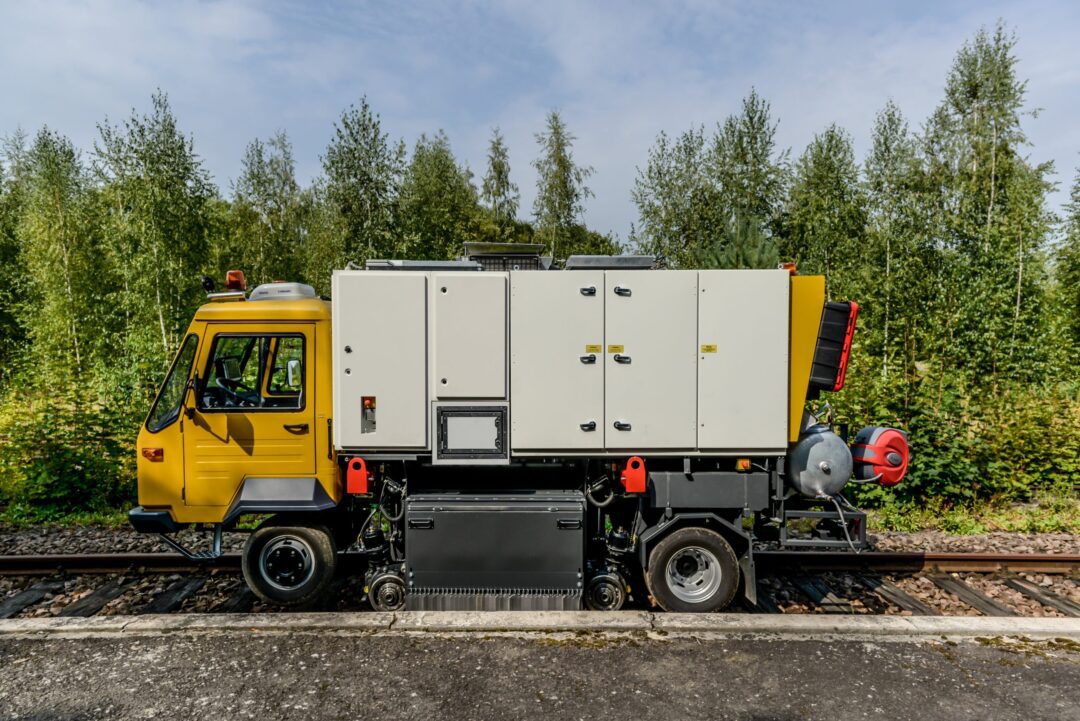
The Harsco Möser Ro‑V 149 rail grinder is a compact road-rail machine for metro, light-rail and tram networks. It uses six grinding spindles for reprofiling and removing corrugation or mill scale. Current Möser data identifies the platform as Ro‑V 149.3; historical Harsco material describes a different UK Ro‑V 149 configuration.
Last source review: 17 September 2026 · Current manufacturer data plus historical UK deployment data
What is the Harsco Möser Ro-V 149?
The Ro‑V 149 family is a lightweight road-rail grinding platform developed by Möser Maschinenbau. Harsco Rail announced a UK distribution and contracted-services partnership for the machine in 2019, positioning it for metro, light rail and tram work.
The compact machine is designed for rail reprofiling, corrugation removal and mill-scale removal. Its road-rail configuration allows deployment close to the worksite and operation in constrained urban clearance envelopes.
Model-generation note: the supplied Möser URL path contains Ro‑V 149.2, its current page title displays Ro‑V 149.3, and Harsco’s 2019 announcement uses Ro‑V 149. Treat the data sets as related platform generations, not one guaranteed configuration.
Möser Ro-V 149.3 specifications
The values below come from the current Möser product page. Confirm the machine data plate and build documentation for any individual Ro‑V 149-series unit.
Why do published Ro-V 149 specifications differ?
The current Möser page lists a 4,700 × 1,900 × 2,530 mm machine, a working speed of 10–20 m/min and 1,000–1,500 mm gauge adjustment. A 2022 Harsco Rail brochure instead lists 5,380 mm length, 1,960 / 2,430 mm road/rail width, 0–5 km/h working speed, 1,435 mm standard gauge and an optional 1,000–1,676 mm range. Railway-News reported another UK envelope of 5,152 × 2,020 × 2,577 mm in 2019.
Do not combine these values into one specification. The differences indicate platform generation, customer configuration or publication-date changes. Use the machine data plate, serial number and build documents when planning clearance, transport or operating work.
Ro-V 149 road-rail grinding features
Compact envelope
Designed to fit restricted urban clearance profiles and narrow access locations.
Road-rail deployment
Road and rail mobility supports transfer close to light-rail and tram worksites.
Six spindle units
Separately movable grinding units support work across varied rail geometry.
Dust extraction
The current product page publishes extraction capacity of 8,000 m³/h.
Where is the Möser Ro-V 149 used?
Compact reprofiling and surface treatment within restricted urban infrastructure.
The UK launch material lists tram networks and grooved-rail applications.
Historical Harsco material identifies switches, check-rail curves and road crossings.
Manufacturer-listed treatment for corrugation, rolling skin and rail reprofiling.
How is the Ro-V 149 suited to urban rail work?
Its compact road-rail layout addresses the access constraints common to tram and metro networks. Harsco’s 2019 UK launch material reported a 75 dB noise level, fuel consumption up to 15 litres per hour and transfer on or off rail in under two minutes. It also cited maximum CO₂ emissions of 60 kg per hour.
These figures describe the historical UK configuration, not a guaranteed specification for every Ro‑V 149 or the current Ro‑V 149.3. Confirm local noise limits, emissions rules, clearance and possession requirements before deployment.
Who makes the Ro-V 149: Harsco Rail or Möser?
Möser Maschinenbau is the machine manufacturer. In July 2019, Harsco Rail announced a partnership covering UK distribution of the Ro‑V 149 and its availability through Harsco contracted services. This is why search results and brochures may use both “Möser Ro‑V 149” and “Harsco Rail by Möser.” For the wider equipment family, see the Harsco rail grinding machines guide.
Möser Ro-V 149 vs Harsco RGH10C and RGH20C
Selection summary: Ro‑V 149 is distinguished by road-rail mobility and compact urban access. Final selection depends on clearance, gauge, curve geometry, switch work, possession time, output and the exact delivered version.
Consumable information intentionally excluded
This page does not recommend a grinding-wheel or stone model. The supplied public sources do not establish a complete, configuration-specific consumable specification suitable for procurement. Confirm the exact machine version, spindle interface, approved drawing and manufacturer documentation before adding compatibility information.
Harsco Möser Ro-V 149 FAQ
What is the Möser Ro-V 149?
A compact road-rail grinding machine for metro, light-rail and tram applications, developed by Möser Maschinenbau.
Is it a Harsco machine?
Möser is the machine manufacturer. Harsco Rail announced a UK distribution and contracted-services partnership for the Ro‑V 149 in 2019.
Is the model Ro-V 149.2 or Ro-V 149.3?
The supplied Möser URL path contains 149.2, while the current page title displays 149.3. Harsco’s 2019 announcement uses Ro‑V 149. Confirm the data plate and documentation for the individual machine.
How many grinding spindles does it use?
The current Möser page publishes six variable-speed spindle units rated at 7.5 kW each, with 11 kW short-term power.
What track gauges can it support?
The current Möser page publishes stepless adjustment from 1,000 to 1,500 mm. The 2019 UK article reported 1,000 to 1,667 mm for that configuration.
What is its working speed?
The current page publishes 10–20 m/min. The historical UK article reported 0–5 km/h, so version and configuration must be confirmed.
Can it grind switches and grooved rail?
The Harsco UK launch material lists switches, check-rail curves, grooved rail and road crossings among its applications.
What grinding stone fits the Ro-V 149?
This page does not specify one. Confirm the exact version, spindle interface, approved drawing and manufacturer documentation before selecting a consumable.
Sources and editorial review method
- Möser Maschinenbau Ro‑V 149 product page — current manufacturer data and image.
- Harsco Rail by Möser Ro‑V 149 brochure — official 2022 Harsco configuration data.
- Railway-News: Harsco–Möser UK launch — 2019 partnership and UK deployment claims.
- Bibliothek für Schleifzüge — related machine entries.
Editorial review: compiled on 17 September 2026. Manufacturer, distributor and historical reporting sources were compared rather than merged. Current and historical version data remain separate, and no grinding-wheel compatibility claim is made.