Plasser & Theurer ATMO Rail Grinding Trailer
The Plasser ATMO is a compact rail grinding trailer for acoustic and preventive maintenance on tram and light-rail networks. It combines oscillating and sliding grinding, works in curves down to 17.5 m radius, and can treat Vignole rail, grooved rail and rail embedded in road surfaces.
Source review: Plasser & Theurer official product information and InnoTrans 2022 ATMO brochure
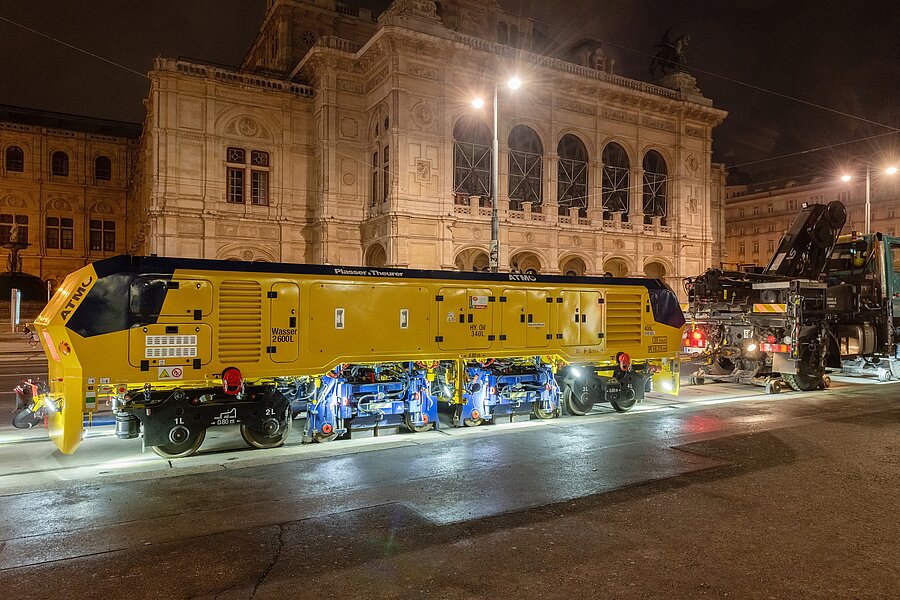
What is the Plasser ATMO?
ATMO stands for Automatic Track Machine Oscillator. Plasser & Theurer developed the machine as a compact, unstaffed grinding trailer for urban rail maintenance, particularly tram and light-rail networks where narrow structure gauges, small curve radii and short maintenance windows restrict the use of larger grinding vehicles.
The trailer has its own power supply for the grinding equipment but is not presented as a self-propelled vehicle. It can be pushed or pulled by a suitable rail vehicle or road-rail vehicle, allowing operators to adapt the consist to local fleet and access conditions.
Short answer: ATMO is selected for acoustic and preventive grinding in constrained urban networks. Its main distinction is the combination of intensive oscillating grinding and speed-flexible sliding grinding in one trailer.
How does the ATMO grinding system work?
The stones move longitudinally over the rail surface. Plasser & Theurer states that this mode achieves a higher removal rate than sliding grinding and supports more intensive treatment of local surface irregularities.
The stones remain in sliding contact with the rail as the trailer moves. This mode supports flexible treatment at different speeds and does not require a minimum processing speed.
The grinding-unit design keeps the stones aligned with the rail head through tight curves. The current manufacturer page specifies a 17.5 m minimum radius in working mode.
Water rinses the grinding stones. The manufacturer describes the process as producing no flying sparks, reducing fire risk in street-running and vegetation-adjacent environments.
Where is Plasser ATMO used?
Smoothing rail-head irregularities helps reduce wheel-rail excitation, rolling noise and vibration at the source.
Regular light treatment helps control early surface deterioration before more intensive rectification is required.
Sliding wet grinding can remove leaf residue, lubricant films and other deposits that impair wheel-rail adhesion.
The system is intended for Vignole rail, grooved rail and rails embedded in road surfaces.
Published deployments and manufacturer reports describe work with Wiener Linien, Odense Letbane and demonstrations in other European urban networks. Results depend on rail condition, grinding parameters, number of passes and the selected consumable.
What performance results have been reported for ATMO?
Plasser & Theurer has published results from development testing and customer applications. These figures show what specific configurations achieved; they are not guaranteed values for every rail condition or operating programme.
How to interpret the numbers: removal, roughness improvement and noise response depend on rail hardness, contamination, defect wavelength, vertical force, oscillation settings, working speed and number of passes.
Plasser ATMO gallery
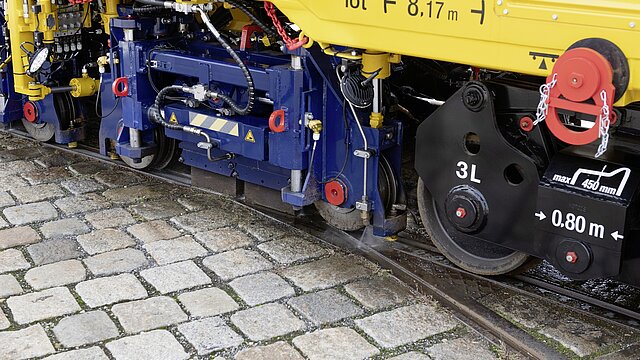
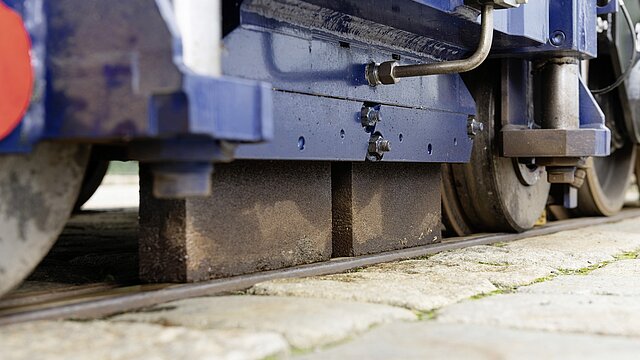
Plasser ATMO technical data
The current public product page places the detailed machine datasheet behind a contact form. Values not openly confirmed by the manufacturer are intentionally omitted here.
Why use ATMO in an urban network?
The compact trailer can be integrated into suitable train formations and used without an additional line closure where local operating rules permit.
Tight curves, narrow clearances, grooved rail and embedded track are central design conditions rather than secondary applications.
Acoustic grinding treats the rail surface that excites wheel-rail noise, supporting quieter vehicle passage.
No minimum grinding speed enables treatment through operational speed changes and constrained urban sections.
How is ATMO different from a conventional rail grinding train?
This comparison describes machine classes, not a universal capability limit. Project planning should be based on measured rail condition, removal target and operator-approved treatment parameters.
What remains configuration-specific?
The machine page and public project reports describe the process and operating concept, but do not provide a public, universal grinding-stone specification. Stone geometry, abrasive formulation, mounting, approved speed and treatment parameters may vary by machine configuration and contract.
No grinding-wheel claim is made on this page. A consumable reference should be added only after the installed ATMO grinding-unit drawing, stone marking and Plasser & Theurer approval documentation are available.
Plasser ATMO FAQ
What does ATMO stand for?
ATMO stands for Automatic Track Machine Oscillator.
Is the ATMO self-propelled?
It is presented as a grinding trailer that is pushed or pulled by a suitable rail vehicle or road-rail vehicle.
Which grinding methods does it use?
It combines oscillating grinding and sliding grinding in one working unit.
What is the minimum working curve radius?
The current Plasser & Theurer product page specifies 17.5 m in working mode.
Which rail types can ATMO treat?
The manufacturer lists Vignole rail, grooved rail and rail embedded in road surfaces.
Can ATMO work at low speed?
Yes. Plasser & Theurer states that preventive treatment can be performed at different speeds without a minimum processing speed.
Why does the process use water?
Grinding-stone rinsing supports wet grinding and prevents flying sparks, reducing fire risk.
Which grinding stone fits the ATMO?
A universal public stone specification has not been verified. Confirm the machine configuration, stone marking, dimensions, mounting and approved documentation before selection.
Sources and review notes
- Plasser & Theurer – Plasser ATMO, current official product page.
- Plasser & Theurer, Plasser ATMO – Acoustic and preventive grinding, InnoTrans 2022 brochure.
- Quiet rails thanks to ATMO, manufacturer technical article.
- Research developments for urban rail, ATMO development background.
Editorial review: 17 September 2026. Current manufacturer values take precedence over earlier prototype figures. No grinding-stone compatibility is claimed.